
Skip to content

High school onboarding

Your program, from yes to your first final whistle.

Everything between saying yes and your first game: what we need from you, what your desk does on the night, and what your spectators and coaches get out of it.

  • Ready in about a day
  • NFHS rules preset
  • One-button scoring
  • First season free

Before your first game

You do not build anything. Send us four things, we set the program up, and you get a link. You can start in the middle of a season too. Backfilling a game that has already been played takes a few minutes each.

The four things to send us

This is the whole intake. Send it however it already exists. We would rather transcribe a photo of a printed schedule than have you retype it.

  1. Your school, and which squads you want set up (varsity, JV, boys, girls)
  2. Your schedule: a link, a PDF, a spreadsheet, or a photo of a printout
  3. Your rosters, if you have them handy. Cap numbers and names is enough
  4. Who is actually at the desk on game night, and what device they will use
Missing a piece is not a blocker. A schedule alone is enough to get started. Rosters can land later.

What one volunteer at the desk produces

Worth knowing before you brief anyone, because it sets expectations for what the desk is responsible for. One person scores the game on a phone or tablet. Everything else follows from that single stream of taps, with no second job attached to it.

  • Live score, visible to anyone following your team in about five seconds
  • Box score, exclusions and shot detail: as much or as little as your desk wants to enter
  • Season records and standings that update themselves, including ties
  • A coaches report in your school’s colors that you can print or email
There is no separate stat sheet to reconcile afterwards, and no second volunteer needed to keep one.

Your invite link, and who should open it

We send one invite link per person who needs to administer the program. Open it at admin.eggbeater.app and it binds to the account you sign in with, so it is worth being deliberate about who clicks it.

  • The link is single-use and binds to the first account that opens it
  • Do not forward it. Ask us for a second invite instead. They are free
  • Anyone can be an admin: the head coach, an assistant, a team volunteer who runs logistics
  • Losing the link is not a problem. Ask and we will send another.
Signing in is Google or Apple. There is no password for you to invent or remember.

The rules are already set for NFHS

You should not have to configure a rulebook. High school play is the default, and the parts that most often get scored wrong are already handled.

  • Quarters or halves, whichever your section plays. The period labels follow your choice
  • A 30-second shot clock
  • Overtime is two three-minute periods, then sudden victory
  • No shootout: a tie is a legal final result, and it counts properly in your record and the standings
If your league runs something non-standard, tell us and we will set it before your first game, not after.

What week one actually looks like

A realistic timeline, assuming you send the intake on a Monday and play on a Thursday.

  • Monday: you send the four things above
  • Tuesday: we set the program up and send your invite link
  • Wednesday: your desk volunteer opens practice mode for ten minutes and scores a fake game
  • Thursday: you score for real, and the spectators following see it live
The practice run is the step people skip and then wish they had not. It costs ten minutes and it is the difference between a confident desk and a nervous one.

Rosters and schedule

Two things have to be right before game night: who is on your roster and when you play. Both are editable from your phone, and both can be fixed in the middle of a season without losing anything already recorded.

Getting your roster in

Three ways, in ascending order of how much you already have typed up somewhere.

  • Type it: cap number and name, about two minutes for a squad
  • Paste it from a spreadsheet
  • Photograph a printed deck roster and let the scan read caps and names, with a review step before anything saves
A missing roster does not stop you scoring. The desk can record goals against cap numbers and you can attach names afterwards.

If you field two squads

A program running an A and a B squad, or varsity and JV, gets a separate roster and a separate record for each. Three details matter and all are handled for you.

  • Cap numbers restart per squad, so both squads can have a number 1 and they stay different people
  • Stats attach to the player, not to the cap. A player who changes caps during the season keeps their season totals
  • When your two squads play each other, that game is marked a scrimmage and kept out of both records
That last one exists because a program beating itself used to bank a win and a loss at the same time. It does not any more.

Your schedule

Enter games one at a time, paste a block from a spreadsheet, or send us the schedule and we will load it. Tournaments collapse into a single row and do not swallow your league schedule.

  • Date, opponent, venue and start time is the full requirement
  • A tournament entry becomes one collapsed row with its own record, openable to see the individual games
  • Adding or moving a game later is immediate. Spectators see the change without doing anything
Venues carry directions, so a spectator driving to an away pool for the first time is not guessing.

If we loaded your school in advance, read this one

We already hold public data for schools across every state that plays, and where it exists we use it so you have less to type. Coverage is uneven. In California, roughly one school in six has anything usable, and it is better you hear that from us than find it out on a Tuesday afternoon.

  • Many schools publish varsity only, so a JV roster may arrive empty even when varsity looks complete
  • An empty roster is the source being thin, not the app failing. You can type one in either way
  • Names sometimes arrive in the casing the original desk typed them in, and we repair only the clearly broken ones. We do not guess at acronyms
  • Anything we load in advance is yours to overwrite. Your edit always wins.
If your school looks wrong or missing, that is worth telling us. It usually means we have not found a public source for you yet, which is a thing we can fix.

Game night at the desk

This is the part to hand to whoever sits at the desk. The short version is that one tap keeps the game honest, and everything past that first tap is optional.

The five-second version

A first-year desk can run an entire game on one button. Tap Goal for the team that scored and you are done. That is live on every phone following the game in about five seconds, and it is a complete, legitimate way to score.

  • Tap the scoring team. That is the whole interaction.
  • The clock, the period and the score stay in step on their own
  • Nothing else is required for the game to count
Do not let a nervous volunteer believe they have to capture everything. One button is a real answer.

Or keep going, as far as you want

The scorer is progressive, not tiered. The same board a first-year desk taps a dozen times is the board an experienced desk runs the full chain on. You never migrate off it. You grow into more of it.

  • Who scored, then shot type, then assist, then where the shot came from
  • The shot location step is explicitly optional and has a Skip
  • Opponent tracking is a toggle that is off by default
  • A desk running the full chain gets shot charts and exclusion tendencies out of the same game
Turn one extra step on per game, not all of them at once. A desk that adds assists in week two and shot location in week four ends the season doing everything.

The scorer password

Scoring is gated by a password that is separate from anything public. Anyone can follow. Only your desk can write.

  • Set it once in the admin panel and give it to whoever is at the desk
  • It is not the same as any code you hand out to spectators
  • Change it whenever your desk crew changes. Nothing already recorded is affected
A volunteer does not need an account of their own to score. The password is enough.

Exclusions, and what the board handles for you

The parts of high school scoring that are easy to lose track of at speed are the parts the board tracks.

  • Three exclusions and a player is out. Enforced, not remembered
  • The re-entry countdown runs on the game clock, so it stays silent while the clock is stopped
  • A forced ball under is recorded as a turnover, because that is what it is
Ask the board instead of recomputing in your head. It knows about brutality and the exclusion kinds that do not behave like the others.

Ending the game cleanly

The one step worth being deliberate about. Finalizing a game is what turns it from a live game into a result. It closes the game, writes the box score and lets the record and standings update.

  • Finalize at the final whistle, from the same board you scored on
  • A game left unfinalized keeps presenting as live, which is confusing for anyone following it
  • If you forget, you can finalize it afterwards. Nothing is lost. It is only late
If a game is ever stuck looking live, tell us. It is a two-minute fix on our side.

Practice mode

A local board that behaves exactly like the real thing and broadcasts nothing. This is where a new desk volunteer should spend their first ten minutes.

  • Nothing entered in practice mode reaches spectators or your records
  • Available without signing in, so anyone can rehearse before they ever volunteer
  • Use it to try the full chain once so game night is not the first time
It is also the honest answer to “what if I press the wrong thing”. Press the wrong thing in here first.

Spectators, coaches and the season

What the rest of your program gets out of the desk doing its job. None of this needs separate work from you. It is the same stream of taps, read three different ways.

What spectators in the stands see

You share one link. Anyone who opens it can follow your team, in a phone browser or in the app, and see the game as it happens.

  • Live score and clock, refreshing on its own
  • The box score as it builds, not after the fact
  • Schedule, results, standings and season records
  • Grandparents three time zones away see the same thing as the spectator on the pool deck
Share it once in your team group chat at the start of the season and you are largely done.

Notifications, for the people who want them

Following a team is opt-in per person, so nobody is subscribed to anything by accident.

  • A notification when a followed game goes live and when it goes final
  • On iOS, a live score on the lock screen for the length of the game
  • Every one of these is the individual spectator’s choice, not a program setting
Nothing you do at the desk decides what lands on anyone’s phone.

The coaches report

The output side of the season, and the piece coaches tend to actually use. In your school’s colors, printable, and generated from games you already scored.

  • Contributions for each player across the games they actually played
  • Exclusions drawn and earned
  • Shot tendencies and zone charts, for any team whose desk recorded shot locations
  • Openable from your own team page with the password you already have
The shot sections only appear when there is shot data to draw. A team that never turned that step on gets a report without them, not an empty chart.

What accrues over a season

Nothing here is a separate job. It is what a season of finalized games adds up to.

  • Season records that count ties properly and exclude your own scrimmages between squads
  • Season totals for each player that follow the player, not the cap
  • Standings that stay current without anyone maintaining a spreadsheet
  • A permanent archive of every game, loadable into next season
This is the argument for finalizing games promptly. Everything above is downstream of it.

The Colorado console

The console runs the clock. Your scorer runs everything else, from one screen.

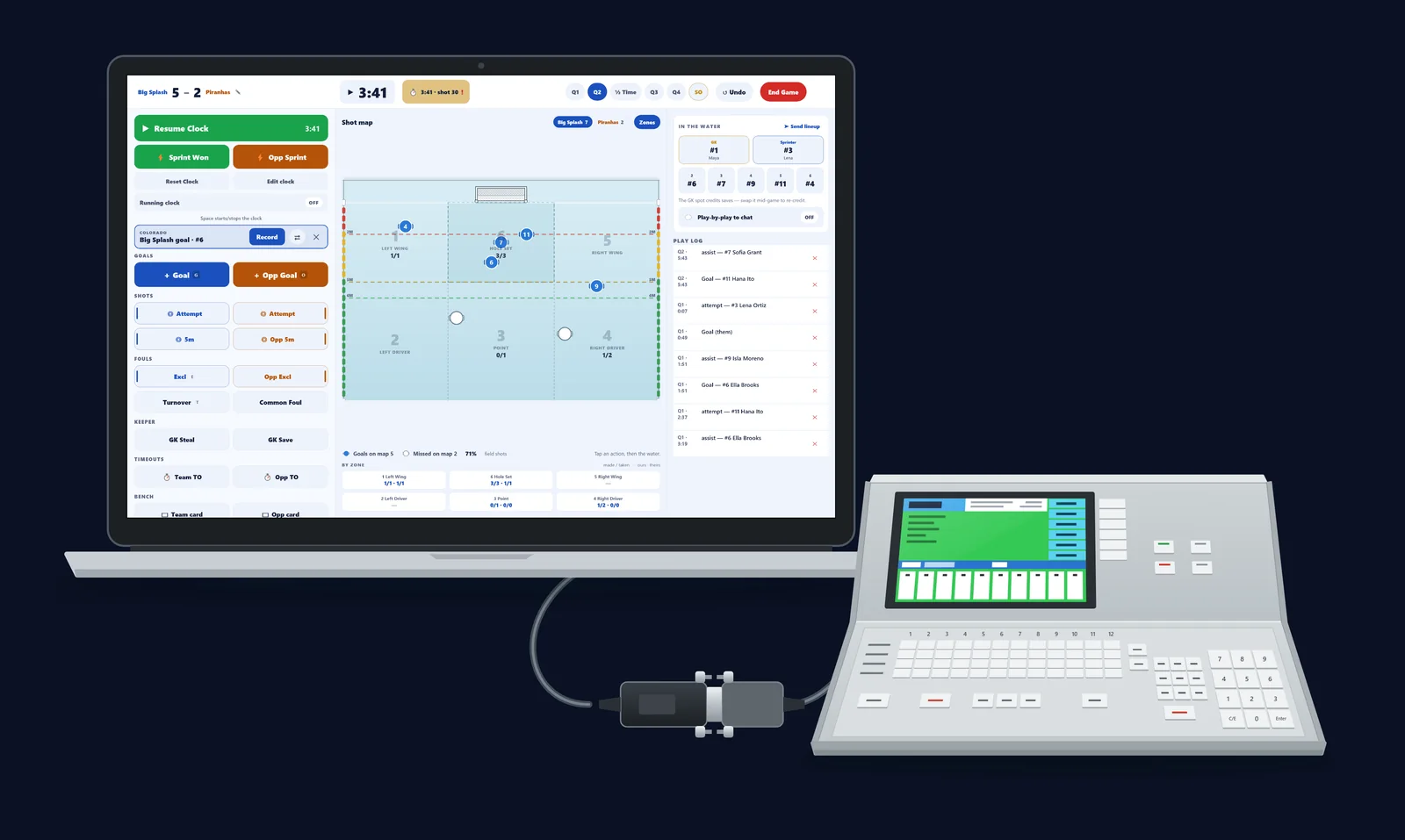
Eggbeater Desk works with Colorado Time Systems System 6 consoles. The console already sends its digits to the pool’s scoreboard through its Scoreboard jack, and the Desk reads the same signal. Once it is connected, the game clock, the period, the breaks and the shot clock follow the console, and every goal and exclusion the table enters shows up on the Desk with the cap number, one tap from the record.

Console reading runs on a Windows PC or a Mac. iPad and Android tablets run the Desk without the console, because tablets have no serial port. The console features are rolling out now, so update the Desk before game day.

A laptop running Eggbeater Desk mid-game, a System 6 timing console, and a USB serial adapter hanging between them on its cables.
The kit, plugged in: a System 6 console, a USB serial adapter and Eggbeater Desk on a laptop. Illustration; the Desk on screen is the real app, with sample teams.

What the console takes over

The console keeps the time.

  • There is no clock to run. The game clock, the period, start and stop, and the shot clock all follow the console.
  • Quarter breaks and half time. The quarter holds at 0:00 and the break counts down beside the clock. Spectators see the same countdown.
  • Goals and exclusions arrive as prompts. When the table enters a goal or an exclusion on the console, it appears on the Desk as a COLORADO prompt with the cap.

You keep the game.

  • You still tap shots, saves, turnovers, timeouts and cards on the Desk, the same as always.
  • Record fills in the player and opens the rest (shot type, assist, where it went in, where it came from), and you can skip any step. The dismiss button clears it. No cap on the board? The prompt says “which cap?”, and Record asks you who it was.
  • Each prompt carries three buttons: Record, swap and dismiss. Nothing counts twice. Nothing is ever recorded by itself. Every prompt waits for your tap.
  • Who’s in the water. The goalkeeper and sprinter slots, and the rest of the seven in the water.
  • End the game. Click End Game, add both referees’ names if your host requires them, and End game publishes the final. Resetting the console never moves the finished game.

The setup guide takes you from the parts to the final horn. Read the setup guide. Open the Desk guide.

Colorado Time Systems and System 6 are trademarks of their owner. Eggbeater is not affiliated with or endorsed by Colorado Time Systems.

Questions

Questions programs actually ask

What does the first season cost?

Nothing. The first high school season is free, and that is the whole season, not a trial window that closes partway through it. We would rather you finish a season and decide than evaluate a demo.

Can we start in the middle of a season?

Yes, and it is common. Games already played can be backfilled in a few minutes each, so you are current from your next game. You do not have to wait for a natural starting point.

Our desk volunteer is different every week. Is that a problem?

No. That is the normal case and the design assumes it. There is nothing for a volunteer to install or sign up for, and a first-time desk can run a whole game on one button. Point each new person at practice mode for ten minutes beforehand and they will be fine.

Do spectators need to create accounts to follow?

No. Anyone with your team link can follow along. An account only matters for people who want notifications tied to a specific team, and that is their choice to make, not yours.

What if the roster you loaded for us is wrong or empty?

Overwrite it. Your edit always wins. Empty JV rosters are common because many schools publish varsity only, so that is the public source being thin, not the app failing. Typing a squad in takes about two minutes.

What device does the desk need?

A phone works. A tablet is more comfortable, and if your program has a dedicated scoring table there is a desk-specific layout built for a bigger screen and a keyboard. Any of the three scores the same game the same way.

Can we score scrimmages?

Yes. Games between two of your own squads are automatically marked as scrimmages and kept out of both records, so a scrimmage never inflates or damages your season record.

What happens to our data at the end of the season?

It stays. Every finalized game and roster is archived permanently, feeds your season history and player totals, and can be loaded back in when the next season starts.

Ready to get your program set up?

Send us your school, your squads and your schedule and we will do the building. If you are already set up, your admin panel is one tap away.