Skip to content

Desk guide

You are at the game desk. Here is the whole board.

Everything the volunteer running the scoring table needs: installing it, opening the live game, running the clock hands-free, and the rules the referee expects the desk to keep.

  • Hands-free clock
  • Tap the water
  • Rules handled

Getting started

Install it free on the iPad you take to the pool, open your club, and the board opens on the game in progress. Have a Colorado console at your pool? Connect it with the setup guide.

What Eggbeater Desk is

Eggbeater Desk is a scoring console for the volunteer at the game desk. It is a separate app from the Eggbeater spectator app. The Desk is the one that writes the score, and everything it records reaches spectators, the TV and the box score within about five seconds.

  • One screen. The actions, the clock, the shot map, the lineup and the play log are all in view at once. You should never scroll mid-game.
  • Free, on the iPad you already have. The Mac version is on the same free listing. One app, one download, whichever you end up with at the table.
  • It is not required. A phone can still score a game from the Eggbeater app. The Desk is what you want when you have a table.
You do not need an account to follow a team, but you do need your club’s scoring password to score one.

Install it

Download Eggbeater Desk from the App Store on an iPad. It is free, and there is nothing to buy inside it. The Mac version is on the same listing: a real Mac app, not a stretched iPad one, where the keyboard does the work and the window resizes like anything else.

  • iPad. Search the App Store for “Eggbeater Desk”. It is free, and you can install it today.
  • Mac. On the Mac App Store, on the same listing, and free there too. Nothing extra to pay.
  • Android tablets. Eggbeater Desk is on Google Play, with its own listing. Free there too.
  • Windows. Eggbeater Desk is on the Microsoft Store, with its own listing. Free there too.
If you land on plain “Eggbeater” you have the spectator app. The scoring one says Desk.

Open your club

On first launch, enter the club code your admin gave you, or sign in if your club uses accounts. Recent clubs are remembered, so the second weekend is one tap.

  • Multiple squads. A club can carry several teams. Use the Team button in the header to switch between them. Each has its own games.
  • Wrong club? Leave club in the header puts you back at the code screen.

Pick the game and enter the password

The games list shows every game for the squad you picked, with live games sorted to the top. Tap the one you are scoring. The board asks for your club’s scoring password once, then opens directly on the game. There is no separate “start a game” step.

  • Already in progress? The board seeds itself from whatever has already been recorded, so taking over from another device mid-game is safe.
  • Wrong password. The board still opens so you can set up the roster and clock. It tells you it is not syncing and asks again before anything is published.
The scoring password is set by your club admin. It is not your account password.

Settings: the cog on the games list

The settings cog on the games list is for this device only. Nothing in it is published, and nothing in it belongs to the club.

  • Appearance. Light, dark or follow the device. A pool deck at 8 am and a lit gym at 8 pm are different rooms.
  • Language. English, Spanish or French.
  • Shot map on by default, and Always track opponent stats, so a club that always wants them stops tapping them on every game.
  • Volume buttons run the clock. On by default on iPad, and worth turning off if they get bumped in a bag.
  • Resync rosters, and the version number support will ask you for.
Period format and shot-clock length are not in there. Those belong to your club and live in the admin panel, so there is only ever one place to set them.

Practice first. Nothing is sent.

Open Practice from the games list and you get a real board with a real roster that is not connected to anything. Every button behaves exactly as it does in a game, and nothing you tap reaches a spectator. It is the best five minutes a first-time volunteer can spend.

  • Where the button is. On a Mac or a large iPad, Practice sits in the header of the games list. On an 11-inch iPad the header runs out of room and it moves into the More button (three dots) at the end of that row. Tap that and Practice is inside.
A practice game says PRACTICE in the header and “Practice, nothing sent” where a live game says Live.

Scoring a game

The clock has a hands-free control on both platforms, the actions are down the left, and the water is the biggest target on the screen.

Running the clock without looking down

You should never have to hunt for the clock. Whichever device you are on, there is one control you can hit without taking your eyes off the water, and the app prints it right under the clock so you do not have to remember it.

  • Mac: the keys. The space bar starts and stops the clock. G is our goal, O is the opponent’s, T is a turnover, and Command-Z undoes the last thing you recorded.
  • Mac: the Game menu. It carries the same actions with Command shortcuts, so you can find them without memorizing anything.
  • iPad. The volume buttons start and stop the clock. The rest is the action grid, which is the fastest thing on the board anyway.
  • The keys are a Mac feature. An iPad ignores a hardware keyboard here, so do not go looking for the space bar on one.
  • Clock drifted from the wall clock? Edit clock opens a minutes box and a seconds box. Put the right time in and tap Set. Reset Clock puts the whole period back and needs a long press, because it throws the period away.
  • Coming in the next update. Edit clock opens with the current time already selected, so you can type straight over it instead of clearing it first.
Typing in a text field never triggers a shortcut. You can type a referee’s name with a G in it and nothing scores.

The clock and the period

The board opens with the period and clock already seeded from the schedule. Tap the clock to set an exact M:SS, use Reset Clock to put the period back to full, and Sprint Won to log the swim-off that starts each period.

  • The period bar runs Q1 to Q4, or H1 and H2 if your club plays halves. Your admin sets that in the club’s clock settings.
  • The clock keeps time accurately even if the screen sleeps or the app goes to the background.
  • Prefer not to run a clock at all? Your club can score by period alone. The actions all stay, only the countdown goes.

Record an action, then the player

Everything is action-first: tap what happened, then who did it. There are no plus and minus steppers to nudge, so a mis-tap is one Undo away rather than a score you have to reconstruct.

  • Goal, then who scored, then shot type, then assist (optional), then where it went in the cage, then where the shot came from.
  • Every step after “who scored” can be skipped. Tap Skip and the goal still counts. Detail is a bonus, never a toll.
  • Attempt, 5m, exclusions, turnovers, steals, blocks, GK saves and timeouts all follow the same shape.

The shot map

The pool map is the largest target on the board on purpose. Tap the water where the shot was taken and the dot lands there. The zone tallies underneath build themselves as the game goes.

  • One step at a time. You are asked where the ball went in the cage first, then where the shot was taken.
  • The cage is optional. Tap Skip and go straight to placing the shot. Nothing is lost. The goal still counts, and the map has the whole screen to itself.
  • True pool scale. The board is 20 m by 12.5 m, the same proportions as the half tank you are looking at, so a shot 5 m out looks 5 m out.
  • For / Against. Flip the map to see what the other team is doing to you.
  • Coming in the next update. The cage step opens over the board at full size, and the pool map underneath is full size too, so neither one is squeezed into half the screen.

Who is in the water

The In the Water panel is the seven caps currently playing. Keeping it honest is what makes minutes played and goalkeeper save credit come out right at the end of the game.

  • The GK slot drives save attribution. Swap it when the keeper changes and the saves are credited to the new keeper.
  • The sprinter slot marks who took the swim-off.
  • A player who has been excluded shows a countdown to when they can come back in.
If nobody sets the lineup the game still scores fine. You get no minutes played for anyone.

The Colorado console

The console runs the clock. Your scorer runs everything else, from one screen.

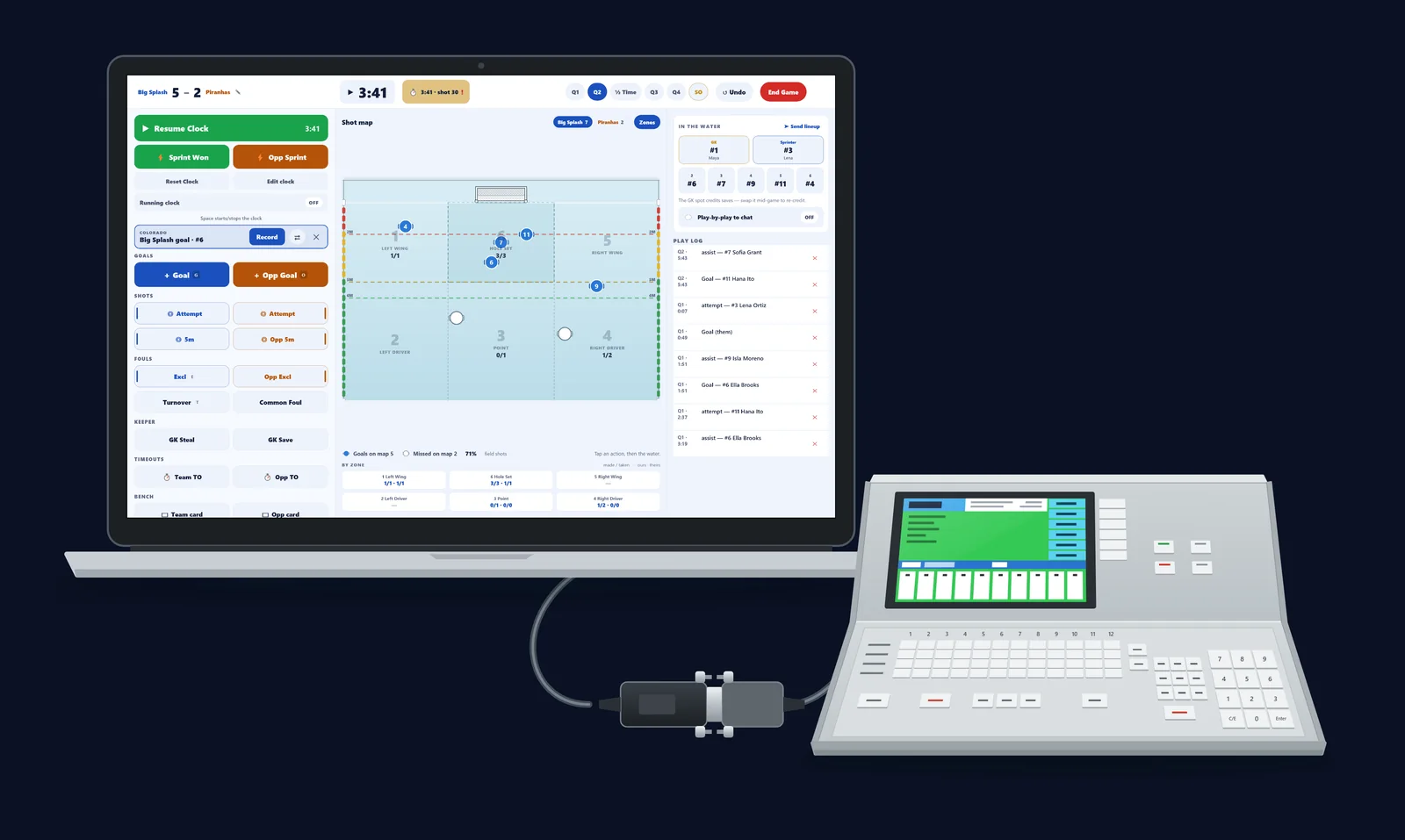
Eggbeater Desk works with Colorado Time Systems System 6 consoles. The console already sends its digits to the pool’s scoreboard through its Scoreboard jack, and the Desk reads the same signal. Once it is connected, the game clock, the period, the breaks and the shot clock follow the console, and every goal and exclusion the table enters shows up on the Desk with the cap number, one tap from the record.

Console reading runs on a Windows PC or a Mac. iPad and Android tablets run the Desk without the console, because tablets have no serial port. The console features are rolling out now, so update the Desk before game day.

A laptop running Eggbeater Desk mid-game, a System 6 timing console, and a USB serial adapter hanging between them on its cables.
The kit, plugged in: a System 6 console, a USB serial adapter and Eggbeater Desk on a laptop. Illustration; the Desk on screen is the real app, with sample teams.

Connect the console

  1. Get the parts. A quarter-inch mono plug wired to a DB-9 (tip to pin 2, sleeve to pin 5) with a pass-through for the scoreboard cable, and a USB-to-RS-232 serial adapter.
    • A pass-through on the tap. The pool’s scoreboard cable plugs back in here, so the scoreboard keeps working. The same job, off the shelf: a ¼-inch Y-splitter plus a ¼-inch-to-DB-9 lead.
    • A USB-to-RS-232 serial adapter. A real RS-232 (DB-9) adapter. Not a “TTL”, 3.3 V or 5 V serial cable. Those do not speak the console’s signal.
  2. Check the console’s scoreboard speed. On the console, open Setup, then Scoreboard. FAST is 9600, SLOW is 2400. Do not change it; pick the same speed in the Desk.
  3. Plug in. Take the scoreboard cable out of the console’s Scoreboard jack, put the tap’s plug in that jack, plug the scoreboard cable into the tap’s pass-through, the tap’s DB-9 into the adapter, and the adapter into the laptop’s USB port. The scoreboard should still show the clock.
  4. Click the Console chip beside the clock. The Colorado console clock panel opens.
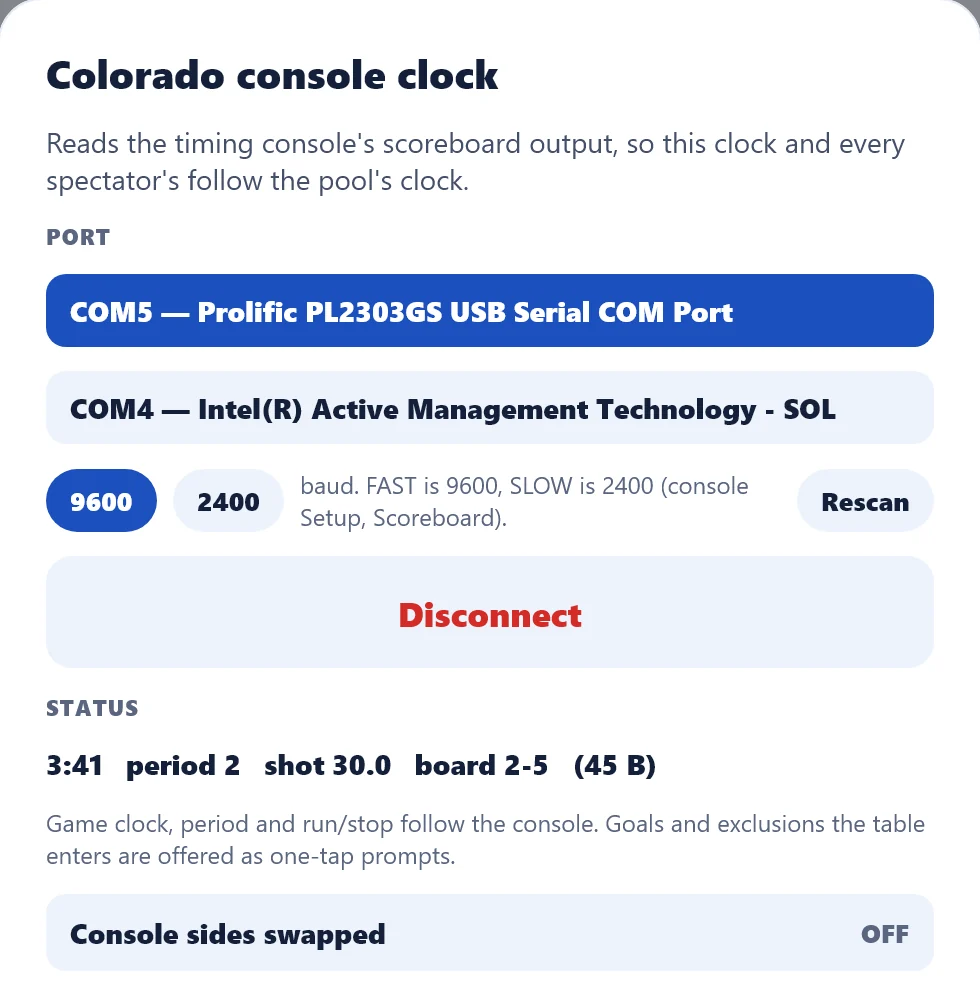
  5. Pick the adapter’s port. On Windows it reads like “COM5” followed by the adapter’s name, such as “Prolific PL2303GS USB Serial COM Port”. See more than one? Pick the one that names the adapter, not the laptop’s own port, like the COM4 in the picture.
  6. Pick 9600, or 2400, to match step 2.
  7. Click Connect. The status line reads “Waiting for data” until the first bytes arrive. Then it shows the console’s clock, period, shot clock and the board’s score, with a byte count in parentheses that keeps climbing. For example: 3:41, period 2, shot 30.0, the board’s score, and (45 B). That is the Desk reading the console. Once it is reading, Connect becomes Disconnect.
The Colorado console clock panel: port COM5, Prolific PL2303GS USB Serial COM Port, selected above COM4, 9600 selected, Rescan, a Disconnect button, the status line 3:41 period 2 shot 30.0 board 2-5 (45 B), and Console sides swapped set to OFF.
Connected on COM5 at 9600. The status line reads the console: 3:41, period 2, shot 30.0, the board’s score, and the byte count (45 B). Once it is reading, Connect becomes Disconnect.
On a Mac: install Prolific’s PL2303 macOS driver first, or use an adapter with an FTDI chip. A Mac runs those without a driver.

The Desk remembers the port and the speed for next time.

What the console takes over

The console keeps the time.

  • There is no clock to run. The game clock, the period, start and stop, and the shot clock all follow the console.
  • Quarter breaks and half time. The quarter holds at 0:00 and the break counts down beside the clock. Spectators see the same countdown.
  • Goals and exclusions arrive as prompts. When the table enters a goal or an exclusion on the console, it appears on the Desk as a COLORADO prompt with the cap.

You keep the game.

  • You still tap shots, saves, turnovers, timeouts and cards on the Desk, the same as always.
  • Record fills in the player and opens the rest (shot type, assist, where it went in, where it came from), and you can skip any step. The dismiss button clears it. No cap on the board? The prompt says “which cap?”, and Record asks you who it was.
  • Each prompt carries three buttons: Record, swap and dismiss. Nothing counts twice. Nothing is ever recorded by itself. Every prompt waits for your tap.
  • Who’s in the water. The goalkeeper and sprinter slots, and the rest of the seven in the water.
  • End the game. Click End Game, add both referees’ names if your host requires them, and End game publishes the final. Resetting the console never moves the finished game.

If the numbers disagree

The Desk compares the board’s score with its own. If they differ (say the board reads 6 to 2 and the Desk 5 to 2), the chip turns gold and a red ! appears on it. The Desk never changes the score by itself. See Troubleshooting.

What you seeWhat to do
A red ! on the chipThe board and the Desk disagree on the score. Check the play log. Fix it with Undo, or tap the score to Fix the score, or ask the console operator to fix the board.
Prompts name the wrong teamSwitch Console sides swapped on. The swap button on a goal prompt does the same. Only one exclusion? Tap the swap button on that exclusion prompt.
The numbers jump around or look wrongWrong speed. Try the other one. Or it is a TTL adapter: use an RS-232 adapter.

The setup guide takes you from the parts to the final horn. Read the setup guide. For everything the Desk does with the console once it is connected, read the launch post.

Colorado Time Systems and System 6 are trademarks of their owner. Eggbeater is not affiliated with or endorsed by Colorado Time Systems.

Rules and the desk crew

The things a referee expects the desk to track, handled by the board rather than by memory.

Three and out

A player is out of the game on their third major exclusion. The board counts them, grays the cap when it happens and shows a BENCHED chip, so you cannot pick them by mistake.

  • Common fouls do not count. Only major exclusions do.
  • It applies to the opponent too. A neutral desk serves both benches, so the opposing cap grays out on their third as well.
  • A 5m penalty foul does count toward the three.

NFHS desk duties (high school)

When your club is set to High School, the board prompts you for the two announcements the rulebook assigns to the desk, at the moment they are due.

  • A side’s last timeout: tell the referee.
  • One minute left in the final regulation period: announce it.
These are prompts for you, not something sent to spectators. Tap to dismiss once you have made the call.

A card shown to a coach

A referee can card a coach or the bench, and the desk is the record of it. Under Bench, pick which side, then yellow or red. It lands in the play log with the period and clock, and on the referee’s own sheet at eggbeater.app/ref.

A coach card is misconduct against the bench, not a player exclusion. It never counts toward anyone’s three and out, and it does not stop the clock.

Ending the game

End Game publishes the final. By default it is a simple confirm. Your host can require a referee sign-off first, in which case the board asks for the referee’s name, and a second referee where there are two, before the result goes official.

  • A signed-off final shows “Signed off by [referee]” everywhere the score appears.
  • High school games can legally end in a tie, and a shootout is never offered for them.
  • A finished game can be opened again for corrections. Publishing again replaces the record.

The schedule is wrong: a different opponent today

If your team ends up playing someone other than the schedule says, fix it on the game card before you start, or from the board once you have. The change publishes immediately, so spectators, the TV and the box score all follow.

  • Pick from your own schedule where you can. A team already on it matches the crest and the league tables. A typed name may not.
  • Say whether the new game still counts toward league standings. A replacement opponent is often from a different league than the one you were due to play.
  • Bracket games are not editable here. There the opponent comes from the draw, so an unexpected team means the bracket needs fixing, and that is the tournament director’s job.
Changing it back is the same trip: “Use the scheduled opponent” publishes the original again.

Fixing things

Everything a desk gets wrong mid-game, and the shortest way back.

Undo

The Undo button in the header, or Command-Z on a Mac, removes the last thing you recorded, including the goal it was attached to. Spectators see the correction within seconds.

The play log

Every action lands in the play log with the period and clock time. It is the fastest way to check that the thing you just tapped is the thing that got recorded.

Newest at the top. The play you just entered is the one you can see.

Caps changed at the pool deck

Game roster edits who is dressed and what number they are wearing for this game only. It does not touch your club’s season roster.

  • Today. A player your admin adds in the admin panel shows up once you leave the game and open it again.
  • Coming in the next update: Add player. Someone turns up who is not on the roster, you type the name, and they are in the pickers immediately and stay put if you close and reopen the editor mid-game.
  • Coming in the next update: Refresh roster. It pulls in a roster that changed in admin while you were scoring, without leaving the game.

The score is wrong

Edit Score adjusts the scoreboard directly when something was recorded on the wrong side or missed entirely. Use it sparingly. Goals recorded properly carry the player attribution that the box score and season stats are built from.

The wifi dropped

Keep scoring. Actions queue on the device and sync as soon as the connection returns. The board tells you when it is not syncing rather than pretending it is.

This is why the board never blocks you on a network error. A desk cannot stop because the pool has bad wifi.

Questions

Frequently asked questions

Do I need Eggbeater Desk to score a game?

No. The Eggbeater app on a phone scores a full game too, and for a lot of clubs that is all they use. The Desk is for when you have a table: one screen with everything on it, and a clock you can run without looking down.

Does Eggbeater Desk cost anything?

No. It is free on the App Store. It is a separate app from the Eggbeater spectator app, with its own listing and its own download, but it is free as well, and that one listing covers the iPad app and the native Mac app alike. Eggbeater Desk is also free on Google Play for Android tablets and on the Microsoft Store for Windows.

What is the scoring password and where do I get it?

Your club admin sets it in the admin panel and shares it with whoever is scoring. It is not your account password, and it is what stops a passer-by from changing a live score.

Can two people score the same game at once?

It is safe to take over mid-game. A second device seeds from what is already recorded. But two people scoring the same game at the same time will fight over the record, so hand off rather than doubling up.

What happens if I score the wrong game?

Exit and open the right one. Anything you published on the wrong game can be corrected from that game: open it again and use Undo or Edit Score.

Does the Desk work without internet?

It keeps scoring and queues everything on the device, then syncs when the connection returns. Spectators catch up when it does.

Can the Desk read our Colorado console?

Yes. Eggbeater Desk works with Colorado Time Systems System 6 consoles. The console already sends its digits to the pool’s scoreboard through its Scoreboard jack, and the Desk reads the same signal. Once it is connected, the game clock, the period, the breaks and the shot clock follow the console, and every goal and exclusion the table enters shows up on the Desk with the cap number, one tap from the record. Console reading runs on a Windows PC or a Mac. iPad and Android tablets run the Desk without the console, because tablets have no serial port. The console features are rolling out now, so update the Desk before game day.

Get Eggbeater Desk

Free on the App Store, on the iPad and the Mac alike, and free on Google Play for Android tablets and the Microsoft Store for Windows. Practice on a real board before your first game. Nothing you tap is sent anywhere.